• Home
  • Posts RSS
Blue Orange Green Pink Purple

Tremendous Trifles: Least Favourites

The pictures make it look so easy... {source}
 May I just say that there are few things worse for the temporary state of mind than working nights. One of those few things is thinking one is going to work a night and then being put on call. This throws one's tenuously-regular sleep schedule into further depths of Weird and Insane. All this to say, if my brainwaves seem to vacillate in terms of general coherence and cohesiveness, do me the undeserved favor of chalking it up to sleep patterns.

Heigh-ho, we strike the third-way mark! I think I am not alone when I say that this one gave me an inordinate amount of trouble (as a matter of fact, I know I am not; Jenny has already posted hers).

the fifth day - your least favourite character you've written

The trouble with this question is, I am (in general) a hideous optimist when it comes to people. Characters are people. Therefore, I don't generally stop in the middle of any story and think, 'Man, this person is just the limit!' Furthermore, I think the only people who can hate or even genuinely dislike their characters are people who hate writing.

'Wait!' you say. 'What about villains? Surely you can't like a villain - there must be something said for principle here!' Well... an author can hardly be principled in the usual way of likes and dislikes, and let me tell you why. A character the reader classifies as unlikable for the sake of villainry is, to the writer's eyes, filling his or her function in a plot as ... unlikable characters. This allows us (as writers) to like them insofar as they fill a role, and fill a role well. Oftentimes, they even make us laugh or give us a small amount of pleasure by virtue of their being Interesting. My experience as a writer is not broad (much less universal), but I think it must be difficult for any writer who enjoys his craft to dislike any of his characters, provided they tell the story along with him and it is a story the writer finds worth hearing.

Where do unlikeable characters come from - characters that belong on the "Unfavourite" list? Could it be when characters don't do what we mean them to do? Oftentimes, when characters step outside the scope of the role we give them, the frustration of that does not make them unlikeable because of the added joy of seeing the story develop in ways we did not foresee. The true frustration - the tedious, slow, weight-in-the-pit-of-your-stomach sort of frustration - is when everything goes as planned, and the flaw is in the plan. This is when the author irrationally turns to the character and says "It's all your fault!" and decides that character is her least favourite to write. And if that is how we take least favourite to mean, I have one character who comes pretty darn close.

Barnabas Blunt

I actually did make this one, though the background doesn't belong to me.


This is the recalcitrant hero of last year's NaNoWriMo novel. He was meant to be mediocre, honest, and a little shabby - the sort of fellow who doesn't intend to do anything great, but by working an honest job and being faithful in little things turns out the greatest of them all. But there didn't seem to be any way past the first part about never doing anything great, and he became a rather shifty and lazy chap.

To worsen his plight by contrast, he kept making fascinating friends, while he himself remained tedious and mediocre. He had a fascinating cousin who went to university, and then he made a hilariously dour friend who traveled the country by jumping trains - but would he take a hint? No; he just sludged on through like so much proverbial dull slime. The moments that should have captivated my heart - moments of emotional fire and mental lucidity - only made things worse, because they were contrived and not part of him. Perhaps the worst thing was that I had made him that way on purpose, meaning to Make Something of him, and it turned out my hand was not equal to the task.

It was mostly the wrong sort of thing to try to develop during the rush and bustle of NaNo - that wasn't his fault. Barnabas needed to be grown slowly, and I couldn't afford slowness then. I've set that chap aside 'til I'm ready to let him make his own story; I'm not capable of forcing that kind of plot, which is why it really was nothing short of a moron's game to try it for NaNo. I squeezed past the fifty-thousand-word mark and collapsed in a state of relief at not having to force myself to slog along with my poor, underdone hero. Ah well; live and learn - and I do mean to try his tale again. Slowly. A few sentences at a time. For the sake of the fascinating cousin, if nothing else.
Read More 2 Missages | scribbled by Unknown edit post

Liebster Award: Recommended Reading


"The goal of the award is to spotlight up and coming bloggers who currently have less than 200 followers. The rules of the award are:

1. Thank the giver and link back to the blogger who gave it to you.
2. Reveal your top 5 picks and let them know by leaving a comment on their blog.
3. Copy and paste the award on your blog.
4. Have faith that your followers will spread the love to other bloggers.
5. And most of all - have fun!"

Abigail, my good friend over at Scribbles and Ink Stains and author of The Soldier's Cross (and many other as-of-yet unpublished works), stuck my blog on her list of five for this award. Of course, under-appreciated translates to (as the description of the award details) not very many followers. I do not feel under-appreciated in the slightest, and I don't know if I did that more than two-hundred followers would change that. A few thoughtful comments will cover miles where thousands of "likes" will collapse after inches.

Nevertheless, I give you a list of five blogs that I think ought to be read more. Some of them have not been updated for a little while, which is very vexing - but maybe if people flood them, something will be done about it. The trouble is, I have too many blogging friends whom I think well-worth a read. I am an avid reader of most of those on Abigail's list, and took the liberty of using her selection of them as an excuse not to mention them (dur, that's exertion, wot?). After I had chosen two or three, I noticed that I knew them all in "real life." Inspired by that realization, I decided to finish the list off with folk I have met, or meet with frequently. But these are by no means the extent of my recommendations; if I may point out the list of links on the sidebar currently to your right, you will find reams of good reading material there.

Without further ado, in no particular order:

  1. A Vapor In The Wind. These are the musings of a musician, a tale-spinner, a dreamer, a sometime-photographer, and (most importantly) a bearer and magnifier of the life of Christ within her. She is also incidentally my next-next-younger sister, and we can talk for hours - so I may be a bit biased when I say I always enjoy reading what she has to say. Nevertheless, her blog is a pretty thing.
  2. The Everyday Miracle. Here are the tales and musings of one possessing a much sharper mind and wit than my own! If you don't fancy reading all of her past posts, at least go to the description of the blog (the extra page, on the top bar) and read that. It catches me all around the throat and chest whenever I do. (This is my older sister, and now I promise I am done with plugs for family members. :)
  3. Logbook 98. This is my celebrated literary-genius of a friend. (Her comment, if she comments, will be in the emblem of a verbal scowl now that I've said that.) She's into just about everything beautiful and grand: Old English literature, Sutcliff, poetry - and then she's learning French. No, seriously, she has an eye for beauty and a pen for describing it, and her tales are always delightful, whether she is climbing mountains or purchasing a car.
  4. winged writings, feathered photos. I don't know how I manage to hobnob with all these artistic folk, since I am so limited in this area. But here is yet another dreamer, tale-spinner, and photographer - talented in all, but especially the latter. She calls herself the Odd Fish, but she certainly seems to have her ducks in a row (she needs to post, though!).
  5. Define "Weird". Yet another photographer! Where do I find these folk? ...well, I know this chap through the interwebz, but he is of Jenny and Abigail's crew and we jostled each other's elbows a little in June, so he now belongs to "real life." (I know all life is real, but it's supposed to eliminate confusion.) And he really is a stellar grapher of photos, and he needs more people to nip at his heels so he'll get out and increase his stash of pictures.
I have posted twice today. I shall now go collapse from the strain of it all.Adieu.
Read More 0 Missages | scribbled by Unknown edit post

Tremendous Trifles: Inspiration

Source for image and contest are contained herein.
the fourth day - a novel or writer that has inspired something in your writing style
I consider myself a fairly well-read person. I consider myself a fairly sociable person, too, and I suppose in this matter people and books are very much alike: that is, no matter how far and wide your scope of acquaintances may roam, there will only be a few that are close enough to be friends, to sustain a marked and lasting influence on your life. So with people, so with books - because after all, the source of influence is not mere words on paper, but those words as an expression of the experience of a person, of a human soul. It is not such a surprising thing that people are such close kin to books.

All this to say, I may read far and wide all I wish; when asking personally about the authors and works I love, the smallness of scope and inescapable overlap is painfully obvious. In my post on Chesterton, I hope it was obvious how much that author has influenced me in terms of style, plot, characterization... But Chesterton is too big for this post; it will not contain him. Chesterton has shaken my ways of going about most things, not just writing. Most of the people I read - and love - are that way, but I thought to highlight one that has most obviously and directly had an impact on style. That, after all, is what the question asks.

Alan Alexander Milne

It is impossible to find a picture where this fellow doesn't look dour. Source.
You probably know him as "A.A.Milne," if you are fortunate enough to have read him or heard of him at all. He is the man responsible for crafting the fantastical tales of Winnie-ther-Pooh. Allow me to insert a caveat, or a commendation, or a desperate plea: If you are only familiar with Winnie-ther-Pooh as a result of (unfortunate) exposure to various Disney productions, STOP. I have seen the type of trivialized nonsense that those hideous rip-offs have become, and they are not on par with Milne's writing. When I speak of being influenced by Milne, that is nothing remotely close to being influenced by the Disney children's series. I am sure they are very good sorts of movies in their own way, but they have run down the road of the Slapstick and the Stereotypical. Eeyore is now a symbol for the Cutely Emo... buh. I am sorry if I am insulting anyone's childhood favorite; it is just that your childhood favorite (the movies) insult mine (the book). I will not try to talk you out of your appreciation of the films, but please - go read the original stories. Hilarity and wit abounding in a children's book in ways that we have lost (since children, apparently, are supposed to be incapable of rational thought nowadays).

He's probably so tight-lipped and sour-looking because he just saw a Disney adaptation. Source.
Onwards! How, you ask,does reading Winnie-ther-Pooh influence somebody's style? Well - two things. The first is the clever way of writing for children while writing for adults. Milne's writing grows with the reader. One may read it at six, and find it funny; come back at ten, and find it funnier still; return yet again at sixteen, and realize one's ability to breathe has been replaced by one's compulsion to laugh. This practice of writing at so many levels that one cannot distinguish where they begin and end, one only knows that they are enjoyable at them all - I cannot say it has influenced my style to the point where I can emulate it perfectly, but it has certainly compelled me to write children's stories in such a way that they read "upwards."

On another utterly-non-fangirlish note, doesn't he look like Wimsey from the good adaptations? Source.

Secondly, Milne's prose is funny, and it isn't simply because he's cracking jokes all the time. The way he uses words - period - is hilarious, with that sort of unconscious hilarity that children have. Perhaps this is why children may laugh at it, and be content to listen to it, and yet never fully get it until they grow up. Only Milne's humor takes a new depths, because Milne knows just how funny he is being - and yet he goes on, quite seriously, talking about Woozles and Heffalumps and Pooh and Piglet stumping round and round a tree counting their own tracks multiplying... It is this ability to make fun of oneself in an innocently self-deprecating fashion that seized my attention when I read him years later as a writer. The idea that one can be funny in a roundabout way by using words a little carelessly, but with intention - it had never struck me before. The only unfortunate side of this is that when I am most aware that I have been writing in this way, that is generally the time that somebody marks the section and adds "Badly written. Sounds really pretentious." ...and my response is, "yeah, I kind of wanted to - I mean, it was supposed to be funny..."

The older-age genres, apparently, take themselves far too seriously. But the ability to say things with charming simplicity - seriously, with the quirk of a smile about the eyes, and those undoubtedly the frankly eager eyes of a child - takes great humility and great courage - and such are the things we only outgrow through tragic presumption of being 'too old.'

Owl hasn't exactly got Brain, but he Knows Things. Source.
By way of a general disclaimer, I think that the truly great authors, once read, cannot be entirely recovered from. (This is doubtless true of insipid literature as well, but I think it takes a more persistent battering of exposure, since insipid literature is mostly influential by passivity.) If you have never read A.A. Milne, or found yourself (heaven forbid!) incapable of enjoying him as an adult, you will probably not like my writing - or you will find parts of it stupid and tedious when it means to be funny in a moderately self-deprecating way. Similarly, if you have ever read Chesterton or Lewis, you will probably read my writing and say "Ho! Cheap imitation." Though I can identify a few areas in each where I would wish to be able to emulate that particular point of style, it is not a matter of trying to write like anybody. When it does happen, I can't seem to help it, and neither can you, if you read good books and pay attention while you do so.

"And if anyone knows anything about anything," said Bear to himself, "it's Owl who knows something about something," he said, "or my name's not Winnie-the-Pooh," he said, "Which it is," he added, "So there you are." 

favorite works of this author:
 Winnie-the-Pooh
The House at Pooh Corner 
When We Were Very Young
Now We Are Six
Read More 1 Comment | scribbled by Unknown edit post

Tremendous Trifles: First Times

Credit for the image and contest belong here.
the third day - your first attempt at writing

Oh, good. The keyword is 'attempt.' We can take that word rather loosely.

I first attempted writing when I was five or six. I have forgotten my plots and characters but not, I think, because of the distance of time. I forgot because the plot and characters did not matter much to me then. But I remember well certain other elements of the experience of writing. I can still experience the shiver from the magical act of putting notepaper in a three-ring-binder and making my own book to scribble things in (a blank book! I have never recovered completely from the delight of an scribblin' book). I can find myself, as plainly as yesterday, sitting at a little table in the red room across from Elizabeth and writing with great solemnity, because to write was surely a great and solemn thing then. And while I do not remember much about the people or storyline who populated those pages, I clearly recall a setting with a gate and a waterfall and a rainbow. I so badly wanted to have a waterfall and a rainbow in my own backyard then, you see, and having it live in my own little book of scribblin' was proverbial balm for this thorn in my side.

There were others later, of course: the adventures of Tom (who built a remote control car that terrorised a stewardess), Mark (I don't remember much about him), Joelle (of the infamous crowns-in-the-oven), Elena (who fought bravely in the battle of the Mashed Potatoes) and Anna (who cleaned a castle in a day using a trolley and a bucket); the ramblings of Bertha and Belinda (whom we liked to scorn simply because we had given them such hideous names); the questionably violent tales of Lucinda, Jane, Beatrice, and Sally (with their youngest brother John... I believe law enforcement on the whole was greatly misunderstood in that one); a rewritten script for a Cinderella play (we crocheted all the dresses for our American Girl dolls... including great flouncing, ruffled ones for the step-sisters); the Nancy Drew diaries (full of scathing wit for that poor cliche-of-a-heroine)... But though the names and faces escape me, I shall always remember the waterfall and the rainbow as the first.
Read More 1 Comment | scribbled by Unknown edit post

Tremendous Trifles: Literary Favorites

I like challenges. ...perhaps that is not true as an overarching, general statement about life - but certain challenges, yes. I like ones that make me write blogposts. I like ones where I missed the boat on the first few steps so there are no expectations left.

Oh, look! A challenge that will make me write blogposts - and I've slept through the first day already! How convenient!

(Yes, this is like... Anna-steals-from-Jenny month. Or something.) 

At any rate, the thing is for writers - it covers fifteen days - and the general idea, as far as I can tell, is to make writers write about bookish things.

Source for image and contest both may be found here. :)
Since I missed the first day, I'm going to lump them both together in this post.

day the first - your favorite character you've written

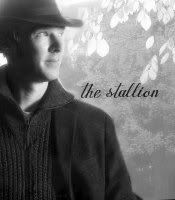
Original photo of Benedict Cumberbatch belongs to the lad himself.
This is my Outlaw. The word for him is dappled, which is hilarious because when I first wrote this character I wrote him as a horse (talking, of course, for he was part of a small girl's childhood, and the good creatures are able to talk there), and he wasn't literally dappled at all. But that is how I see this character, and perhaps why I love him best: seriousness dappled with mirth; rough manners dappled with chivalry; an outlaw dappled with princely jewels... and it's the fact that he keeps it down to this smattering of brightness that make him so splendid. It's a humility that veils without venturing into deception.

I am still not sure how far the humility has taken him; I do not know where he properly belongs, the things he has sacrificed and the reasons he has for losing them. He is not my chummiest character; I have played with some that were far more sympathetic and agreeable. Unearthing his secrets is far from the point of this story, but I write it with the wistful half-hope that it may be one of its by-products. That's the thing about dappled things: like the sunshine smattering the floor of a forest, all his best traits are impossible to pin down - yet they are undeniably there, and their presence reminds us that someday we shall burst out from under the dark ceiling and find our faces fully bathed in the sunlight.

 day the second: your favourite male author


...this question has a malicious ring of impossibility. Basically, everyone I read (with two or three exceptions) are men. Call me a literary tomboy (or a literary misogynist) if you will, I'm afraid it's mostly men: Lewis, Tolkien, Dickens, Collins, Lawhead, Blamires, Wodehouse... to say nothing of the Greek poets and Puritans and sundry theologians that make up the odd mixture of "what Anna likes to read." So I am only looking within the scope of authors who mix the roles of poet, philosopher, and just-plain-darn-good-story-teller. This basically leaves... Lewis, Blamires (less of the poet on that one), and the author I've selected, whom you should have recognized would be my favorite when I left him off the above list.

Gilbert Keith Chesterton. 

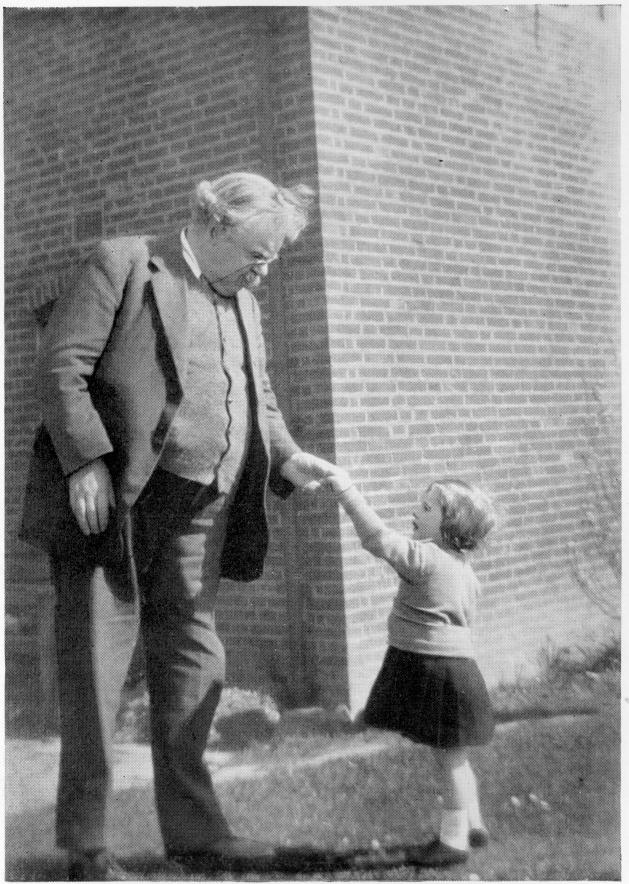
Figuratively speaking, I'm the one on the right. Source: http://gkc.co.uk.

 When I was twelve or thirteen, I took an online Logic course. The instructor wrote the textbook himself, and (being a literary chap) he loved to weave literary things throughout his curriculum. Thus it was that I was provided with a link to an online cache (probably over at Project Gutenberg) of short stories called 'The Father Brown Mysteries.' It made sense, really; taking a logic course and reading mystery stories. So I tried the first one: The Blue Cross. 

It was a sound like Chesterton falling onto a sheet of tin. -P.G. Wodehouse, 'The World of Mr. Mulliner' 

I was not, at that time, acquainted with the likes of Dorothy Sayers, and so had never experienced a mystery story that actually cut deeper than the brain. What I found in Chesterton bewildered me. It wasn't a mystery... not in the strict sense of the word. It wasn't the sort of thing that inspired you to try to figure it out as you went. Father Brown was a priest. His stories were simple, but far too complex in their characters for mysteries. (What's more, he tended to think meanly of Protestants and portray them very unflatteringly.)

At a time when Sherlock Holmes and Hercule Poirot came readily enough to hand, I shouldn't have fixated on the wanderings of this British priest. But there was a mystical, otherworldly quality to Father Brown's work - and all he seemed to be doing was taking an honest and thorough peep at humanity. It seized at my soul; probably because (though I did not realize it at the time) the characters themselves had souls, and (unlike the odd characters that inhabit most mystery stories, even the well-written ones) those souls mattered. I couldn't stop reading.

It baffled and perplexed me at the time, but I haven't been able to shake him ever since. I am not an expert on what makes good literature, and my rough idea of the definition of a 'classic' isn't really the point right now. My intention is to simply give a few selfishly personal reasons why I like Chesterton. (I have a blog. We've already established that I'm basically narcissistic by virtue of that fact. So are you. Get over it.) 

Plainly put, Chesterton's style is gorgeous. His manner of description has a precision lacking in spareness, a rich quality that is free from overindulgence or verbal gluttony. He is a craftsmanship, his skill extending (to my reader's palate) beyond the reach of even the genius talents of Lewis and Tolkien. Don't get me wrong; I adore both of the latter, and find their writing styles quite enjoyable. But Chesterton is a master of description. He is never trying too hard; he merely sees for the reader, and what he sees is beautiful.

The winter afternoon was reddening toward evening, and already a ruby light was rolled over the bloomless beds, filling them, as it were, with the ghosts of the dead roses. (The Complete Father Brown)


Furthermore, Chesterton has a brilliant way of writing a story in layers: he never surrenders the position of masterful storytelling for the sake of making a point. My suspicion is that he simply wrote about people, and the grand statements of truth and beauty couldn't help slipping in. It is only fairly recently that we have begun to view all novels as belonging to the more tedious, cheaply-written class of mystery fiction - where the plot is made of a problem that needs a solution, and each character can be summed up in a simple, equation-like statement of what they need or don't need - and if there is a 'Christian' point, it can only be expressed in terms of an overdramatised conversion scene, or at least showing a nice Christian citizen in a favorable, reasonably intellectual light. If people are people, there will be complex profundities - no man is anything less.


"Do you understand that this is a tragedy?" 
"Perfectly. Always be comic in a tragedy. What the deuce else can you do?"
 (The Man Who Was Thursday)


Because Chesterton's characters are truly people, their stories are as much the stories of humans living in relation to each other and God as they are the stories of political and judicial conflict and resolution. This, I think, is why they are so compelling. Chesterton is the only author I know who can write a story that is totally driven by a love story between a man and a woman without cheapening the story by making the feelings between the man and the woman the point. The plot would not happen without the love story, but the love story is only a small fraction of the plot. I don't know how Chesterton accomplishes this, except by being realistic. They are much more than the stories of a man who likes a woman; they are two people living in right relation before the face of God - they are the simplest and the profoundest people on earth - and of course, somehow, in whatever they do, simple and profound things come bursting through their stories.

"That is it," she said, nodding rather strangely. "Through the worst one could imagine comes the best one could not imagine."
 "I'm afraid I don't follow," said the Junior Partner.
 "You go through the worst to the best, as you go through the west to the east," she said, "and there really is a place, at the back of the world, where the east and the west are one. Can't you feel there is something so frightfully and frantically good that it must seem bad?"
 He stared at her blankly, and she went on as if thinking aloud.
 "A blaze in the sky makes a blot on the eyesight. And after all," she added, almost in a whisper, "the sun was blotted out, because one man was too good to live." 
(Four Faultless Felons)

That's really all there is to it: Chesterton is hilarious and profound, poetic and insanely straight-forward, full of simple complexities and heavy mirth, the reconciler of contradictions (or, rather, the exposer of false contradictions). It was he, the master of characters who are so bizarre that they can only be practically and absolutely human, who taught me to love the beauty of a paradox - the beauty of the human soul. If you have not delved into his stuffs, or you only dabbled with three-halves of separate chapters from Orthodoxy as part of a tedious British Literature textbook in high school - get thee hence and thence.

I have already enjoyed: 
 Orthodoxy
The Man Who Was Thursday
Manalive
Four Faultless Felons 
The Complete Father Brown Mysteries
The Wild Knight (& Other Poems) 

...and with a view of my bookshelf, I anticipate enjoying: 
The Ball and The Cross
Tremendous Trifles
Napoleon of Notting Hill
The Flying Inn
The Everlasting Man
Read More 3 Missages | scribbled by Unknown edit post
Newer Posts Older Posts Home

The Blind Leads:

  • A Spirit Not Of Fear
  • A Vapor in the Wind
  • Define "Weird"
  • Logbook 98
  • Petr's Blog
  • Scribbles & Ink Stains
  • The Everyday Miracle
  • The Penslayer
  • The Poetry of Lost Things
  • Winged Writings & Feathered Photos

The Authoress

Unknown
View my complete profile

Currently Writing:

Currently Writing:
Summary: A raggle-taggle tale of... something. Romance, children's fairy tales, and the misadventures of a detective all thrown together into one cup. Let steep 3-5 minutes. Cream and sugar, according to taste.
Progress: 22,346 words
Status: In-Progress

Currently Listening to:

  • Birds On a Wire - Hawk in Paris
  • Worn - Tenth Ave. North
  • Waking the Dead - MPJ
  • Not With Haste - Mumford & Sons
  • Amsterdam - Imagine Dragons
  • Firstborn Son - Andrew Osenga
  • You'll Find Your Way - Andrew Peterson

Currently Devouring (Figuratively)

  • Signs Amid the Rubble - Newbigin
  • The White Horse King - Merkle
  • Monster in the Hollows - Peterson
  • Little Dorrit - Dickens
  • Notes from the Underground - Dostoevsky

Read the Printed Word!

Twitter & Chirp:

Lighthearted Labels:

A.A. Milne Andrew Peterson Battling Unbelief Beauties That Pierce Like Swords Beautiful People Brokenness Chesterton Darjeeling Falcon Dorothy Sayers Dusty Greeks I Need Jesus Jane Austen Joy in the Journey Lady Jane Life's Soundtrack LifeIsRelationship Love Miss Brewster OMySoul Odd Lewis References Paradoxes Pieces of poems Puritans Steep Tales Story Scribblage Tenth Avenue North The Extraordinary Ordinary Wodehouse Writer's Block

Ancient Scribblings

  • ▼ 2013 (5)
    • ▼ December 2013 (1)
      • Announcing -
    • ► July 2013 (1)
    • ► April 2013 (1)
    • ► March 2013 (1)
    • ► January 2013 (1)
  • ► 2012 (19)
    • ► October 2012 (2)
    • ► September 2012 (1)
    • ► August 2012 (5)
    • ► April 2012 (2)
    • ► March 2012 (2)
    • ► February 2012 (4)
    • ► January 2012 (3)
  • ► 2011 (64)
    • ► December 2011 (5)
    • ► November 2011 (4)
    • ► October 2011 (4)
    • ► September 2011 (3)
    • ► August 2011 (14)
    • ► July 2011 (4)
    • ► June 2011 (6)
    • ► May 2011 (4)
    • ► April 2011 (6)
    • ► February 2011 (6)
    • ► January 2011 (8)
  • ► 2010 (10)
    • ► December 2010 (1)
    • ► November 2010 (2)
    • ► October 2010 (3)
    • ► September 2010 (1)
    • ► August 2010 (2)
    • ► January 2010 (1)
  • ► 2009 (58)
    • ► December 2009 (4)
    • ► November 2009 (1)
    • ► October 2009 (1)
    • ► September 2009 (6)
    • ► June 2009 (4)
    • ► May 2009 (5)
    • ► April 2009 (9)
    • ► March 2009 (6)
    • ► February 2009 (6)
    • ► January 2009 (16)
  • ► 2008 (41)
    • ► December 2008 (4)
    • ► November 2008 (4)
    • ► October 2008 (2)
    • ► September 2008 (6)
    • ► June 2008 (1)
    • ► May 2008 (6)
    • ► April 2008 (9)
    • ► March 2008 (2)
    • ► February 2008 (4)
    • ► January 2008 (3)
  • ► 2007 (8)
    • ► December 2007 (2)
    • ► November 2007 (5)
    • ► October 2007 (1)
  • Search


    • Home
    • Posts RSS
    • Comments RSS
    • Edit

    © Copyright Insanity Comes Naturally. All rights reserved.
    Blog Skins Designed by FTL Wordpress Themes | | Free Wordpress Templates. Unblock through myspace proxy.
    brought to you by Smashing Magazine

    Back to Top