• Home
  • Posts RSS
Blue Orange Green Pink Purple

Tremendous Trifles: Literary Favorites

I like challenges. ...perhaps that is not true as an overarching, general statement about life - but certain challenges, yes. I like ones that make me write blogposts. I like ones where I missed the boat on the first few steps so there are no expectations left.

Oh, look! A challenge that will make me write blogposts - and I've slept through the first day already! How convenient!

(Yes, this is like... Anna-steals-from-Jenny month. Or something.) 

At any rate, the thing is for writers - it covers fifteen days - and the general idea, as far as I can tell, is to make writers write about bookish things.

Source for image and contest both may be found here. :)
Since I missed the first day, I'm going to lump them both together in this post.

day the first - your favorite character you've written
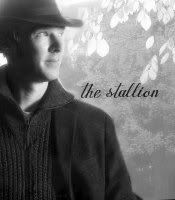
Original photo of Benedict Cumberbatch belongs to the lad himself.
This is my Outlaw. The word for him is dappled, which is hilarious because when I first wrote this character I wrote him as a horse (talking, of course, for he was part of a small girl's childhood, and the good creatures are able to talk there), and he wasn't literally dappled at all. But that is how I see this character, and perhaps why I love him best: seriousness dappled with mirth; rough manners dappled with chivalry; an outlaw dappled with princely jewels... and it's the fact that he keeps it down to this smattering of brightness that make him so splendid. It's a humility that veils without venturing into deception.

I am still not sure how far the humility has taken him; I do not know where he properly belongs, the things he has sacrificed and the reasons he has for losing them. He is not my chummiest character; I have played with some that were far more sympathetic and agreeable. Unearthing his secrets is far from the point of this story, but I write it with the wistful half-hope that it may be one of its by-products. That's the thing about dappled things: like the sunshine smattering the floor of a forest, all his best traits are impossible to pin down - yet they are undeniably there, and their presence reminds us that someday we shall burst out from under the dark ceiling and find our faces fully bathed in the sunlight.

 day the second: your favourite male author


...this question has a malicious ring of impossibility. Basically, everyone I read (with two or three exceptions) are men. Call me a literary tomboy (or a literary misogynist) if you will, I'm afraid it's mostly men: Lewis, Tolkien, Dickens, Collins, Lawhead, Blamires, Wodehouse... to say nothing of the Greek poets and Puritans and sundry theologians that make up the odd mixture of "what Anna likes to read." So I am only looking within the scope of authors who mix the roles of poet, philosopher, and just-plain-darn-good-story-teller. This basically leaves... Lewis, Blamires (less of the poet on that one), and the author I've selected, whom you should have recognized would be my favorite when I left him off the above list.

Gilbert Keith Chesterton. 
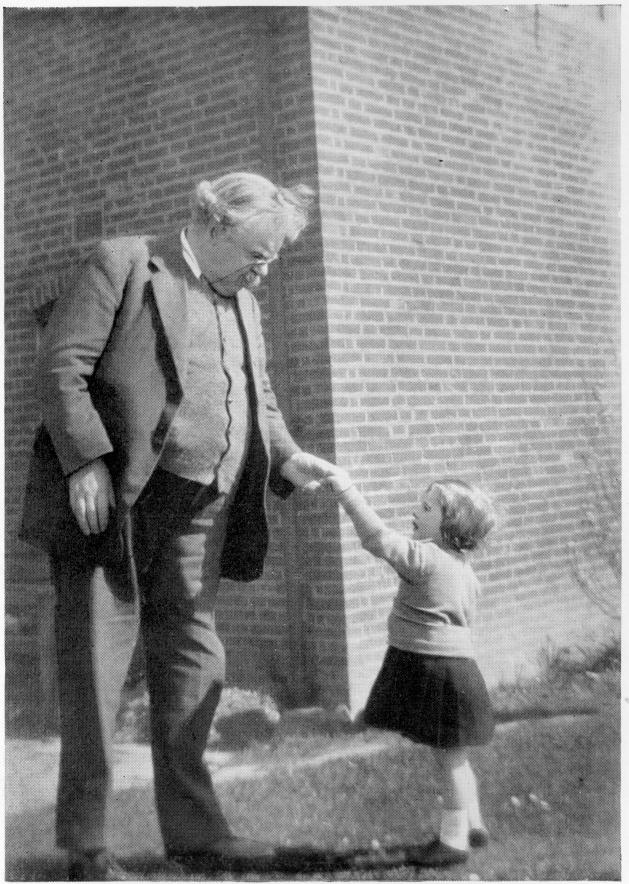
Figuratively speaking, I'm the one on the right. Source: http://gkc.co.uk.

 When I was twelve or thirteen, I took an online Logic course. The instructor wrote the textbook himself, and (being a literary chap) he loved to weave literary things throughout his curriculum. Thus it was that I was provided with a link to an online cache (probably over at Project Gutenberg) of short stories called 'The Father Brown Mysteries.' It made sense, really; taking a logic course and reading mystery stories. So I tried the first one: The Blue Cross. 

It was a sound like Chesterton falling onto a sheet of tin. -P.G. Wodehouse, 'The World of Mr. Mulliner' 

I was not, at that time, acquainted with the likes of Dorothy Sayers, and so had never experienced a mystery story that actually cut deeper than the brain. What I found in Chesterton bewildered me. It wasn't a mystery... not in the strict sense of the word. It wasn't the sort of thing that inspired you to try to figure it out as you went. Father Brown was a priest. His stories were simple, but far too complex in their characters for mysteries. (What's more, he tended to think meanly of Protestants and portray them very unflatteringly.)

At a time when Sherlock Holmes and Hercule Poirot came readily enough to hand, I shouldn't have fixated on the wanderings of this British priest. But there was a mystical, otherworldly quality to Father Brown's work - and all he seemed to be doing was taking an honest and thorough peep at humanity. It seized at my soul; probably because (though I did not realize it at the time) the characters themselves had souls, and (unlike the odd characters that inhabit most mystery stories, even the well-written ones) those souls mattered. I couldn't stop reading.

It baffled and perplexed me at the time, but I haven't been able to shake him ever since. I am not an expert on what makes good literature, and my rough idea of the definition of a 'classic' isn't really the point right now. My intention is to simply give a few selfishly personal reasons why I like Chesterton. (I have a blog. We've already established that I'm basically narcissistic by virtue of that fact. So are you. Get over it.) 

Plainly put, Chesterton's style is gorgeous. His manner of description has a precision lacking in spareness, a rich quality that is free from overindulgence or verbal gluttony. He is a craftsmanship, his skill extending (to my reader's palate) beyond the reach of even the genius talents of Lewis and Tolkien. Don't get me wrong; I adore both of the latter, and find their writing styles quite enjoyable. But Chesterton is a master of description. He is never trying too hard; he merely sees for the reader, and what he sees is beautiful.

The winter afternoon was reddening toward evening, and already a ruby light was rolled over the bloomless beds, filling them, as it were, with the ghosts of the dead roses. (The Complete Father Brown)


Furthermore, Chesterton has a brilliant way of writing a story in layers: he never surrenders the position of masterful storytelling for the sake of making a point. My suspicion is that he simply wrote about people, and the grand statements of truth and beauty couldn't help slipping in. It is only fairly recently that we have begun to view all novels as belonging to the more tedious, cheaply-written class of mystery fiction - where the plot is made of a problem that needs a solution, and each character can be summed up in a simple, equation-like statement of what they need or don't need - and if there is a 'Christian' point, it can only be expressed in terms of an overdramatised conversion scene, or at least showing a nice Christian citizen in a favorable, reasonably intellectual light. If people are people, there will be complex profundities - no man is anything less.


"Do you understand that this is a tragedy?" 
"Perfectly. Always be comic in a tragedy. What the deuce else can you do?"
 (The Man Who Was Thursday)


Because Chesterton's characters are truly people, their stories are as much the stories of humans living in relation to each other and God as they are the stories of political and judicial conflict and resolution. This, I think, is why they are so compelling. Chesterton is the only author I know who can write a story that is totally driven by a love story between a man and a woman without cheapening the story by making the feelings between the man and the woman the point. The plot would not happen without the love story, but the love story is only a small fraction of the plot. I don't know how Chesterton accomplishes this, except by being realistic. They are much more than the stories of a man who likes a woman; they are two people living in right relation before the face of God - they are the simplest and the profoundest people on earth - and of course, somehow, in whatever they do, simple and profound things come bursting through their stories.

"That is it," she said, nodding rather strangely. "Through the worst one could imagine comes the best one could not imagine."
 "I'm afraid I don't follow," said the Junior Partner.
 "You go through the worst to the best, as you go through the west to the east," she said, "and there really is a place, at the back of the world, where the east and the west are one. Can't you feel there is something so frightfully and frantically good that it must seem bad?"
 He stared at her blankly, and she went on as if thinking aloud.
 "A blaze in the sky makes a blot on the eyesight. And after all," she added, almost in a whisper, "the sun was blotted out, because one man was too good to live." 
(Four Faultless Felons)

That's really all there is to it: Chesterton is hilarious and profound, poetic and insanely straight-forward, full of simple complexities and heavy mirth, the reconciler of contradictions (or, rather, the exposer of false contradictions). It was he, the master of characters who are so bizarre that they can only be practically and absolutely human, who taught me to love the beauty of a paradox - the beauty of the human soul. If you have not delved into his stuffs, or you only dabbled with three-halves of separate chapters from Orthodoxy as part of a tedious British Literature textbook in high school - get thee hence and thence.

I have already enjoyed: 
 Orthodoxy
The Man Who Was Thursday
Manalive
Four Faultless Felons 
The Complete Father Brown Mysteries
The Wild Knight (& Other Poems) 

...and with a view of my bookshelf, I anticipate enjoying: 
The Ball and The Cross
Tremendous Trifles
Napoleon of Notting Hill
The Flying Inn
The Everlasting Man
Read More 3 Missages | scribbled by Unknown edit post

The Breaking of a Spell

"Ruth has already got her wedding dress--how queer that is."

The speaker never moved her eyes from the idle scene on the other side of the window as she spoke. Her voice lacked any eagerness to its inflection. Long practice of gossip and news-sharing had robbed these of their sensational novelty. Habit alone dictated their continuing, just as habit kept her disinterested position on the window-seat, looking at the same empty scenery day after day.

"Don't say 'queer,' Alice," another remarked carelessly from her seat across from the window. She had the same tedious, uninterested note to her rebuke--completely lacking severity--as Alice took with the gossip. Her hands rapidly plucked a needle in and out of a sheet of fabric, languid in spite of their motion. "It's becoming unfashionable."

"Crass, you mean," I cut in, the impatience of my tone bursting like black ink over the blank page of the room's stifled atmosphere. "Why can't you just say what you mean, Dot? Crass today and crude tomorrow, and there goes a perfectly good word. Why do people hate words so?"

There was no answer to the question, and its passion slipped away unnoticed in a disagreeably agreeable silence that followed. Alice pretended to be interested in the scenery. Dorothy pretended to be embroidering something. I kicked the carpet angrily and then stamped out the urge to do so again. It was pettish, and I hated feeling pettish. I shifted restlessly on the round piano seat instead, pretending to smooth my skirts.

"Did she spend very much on it?" Dorothy was the only one I knew who could ask a question suddenly without sounding interested. "On the wedding dress, I mean."

"Not above thirty-five or forty dollars, I've heard." Alice blew on the window and wiped away the condensation lazily. "I'm wearing as much in the threads on my back, and this is my day dress."

"At least," I addressed the cover of my book. "At least she cannot be accused of extravagance."

"More like poverty, poor lamb," the endearing term sounded hateful without any associated compassion or spirit. I wanted to throw my book at Dot's face. "But at least she was not extravagant, as dear Anne says, and did not spend outside her means."

Dear Anne! Dear Anne scowled.

"Yes, but for her wedding--" Alice checked her eagerness and continued placidly. "Well, for anyone's wedding a good deal of extravagance is expected. It's practically in the Bible nowadays, along with wives putting their necks under their husbands' feet--poor devils."

I wanted to ask whether she meant the husbands or the wives. Simply groveling like a worm under someone's foot could not be the essence of submission, and the act had a serpent-like connotation that probably indicated the reverse. I thought perhaps I pitied the husband more. Instead, I spread my hands wide and shrugged, announcing:

"I haven't seen the dress myself. I didn't ask. The point is moot, anyway. Ruth hasn't even got a beau."

The useless plucking of Dot's hands at the embroidery cloth stilled. Even Alice's steadfast eyes flickered a moment from their view at the window. Then the fraction of a second passed, and the atmosphere of surprise left the room.

"Hasn't she?" remarked Dot calmly, when Alice seemed too disinterested to take up the subject again.

"No." I did not care to elaborate.

"Who would have her?" asked Alice of the linden-tree.

"Who will have any of us?" demanded I, sounding fiercer than I wished. Perhaps it was not fierce enough. "All we ever do is sit in here and talk of things that none of us care for."

"My dear girl," the linden-tree received a superior smile in my stead. "Anybody would be delighted to have us. That is precisely what every man expects from his wife."

There was no answer for that, except several violent actions which my languid hands would never commit. All my passions were intellect-bound, and I hated myself for it. I turned angrily back to Dot. "Ruth said she knows it's silly, but at least it's not expensive. She calls it her poor, cheap little act of faith."

"I expect they'll saint her tomorrow," said the window-seat.

"Sooner her than any of us!"

"You needn't be hateful, Anne," Dot interjected mildly.

"If I am, I am equally so to myself as any of you. But you are right. I don't need to be. We are hateful enough as it is without anybody saying anything expressly." My own tone was as mild as hers, and I was shocked for a moment to taste spite in it--still more shocked to recognize myself as my opponents' equal in a game of long-seated and placid malice. The realization cut off whatever I had thought to say next. I sat, dumb-struck, for at least ten seconds.

These ten seconds wore into twenty, another uncomfortable and uncompanionable silence. I suddenly remembered a family party in this same parlor, while I was still small and constantly reading in corners. Alice, her recalcitrance much less subdued in those days, had gotten onto the piano seat and persuaded some young, stupid uncle of ours to push her round and round. And so he did - and round and round she went, until I was stomach-sick and furious, my eyes unable to leave the dizzying motion and return to my book.

"I do not consider it an act of faith to pin my hopes up for all to see," Alice remarked at last, her voice cutting through the memory but failing to return me completely to the present. Round and round and round... "No wedding dress for me, until the occasion does merit some extravagance. Then all shall be remarkably well-done."

Dot nodded amiably over her embroidery at the both of us, agreeing with goodness knew what. Mother had nodded in just such a manner, as that stupid uncle talked loudly of some ridiculous story involving a few mutual acquaintances--all were properly shocked, unwilling and yet eager to hear more--the gossip swirled in my ears with the motion of the piano-seat in my eyes--round and round and round--Uncle might have put his foot out and stopped it, but instead he kept slipping his toe over and nudging it 'round again, and I was old enough to know that it did nobody any harm but nobody any good--round and round and round and round and round and round, until-- 

Crash! The piano seat had unscrewed itself, and both cousin and cushion tumbled to the floor with a thump and a shriek. I remembered that moment, when the idle chatter had halted and all the minds which had been so forwardly fixed on the gossip turned for a glorious moment to consider the safety of the child. Alice bawled. Never had there been such a frantic commotion, on the part of adults or child, but I had never seen the contents of the room appear so sensible before--nor have I since.

"I haven't bought my wedding dress," Alice repeated, and I awoke to myself swiveling slightly on the piano seat. I realized I was staring at her, and she was discomfited enough to be looking oddly back. Perhaps if I strode over and yanked her from the window-seat, a second fall... but no. It would take more than a tumble from a seat to wake her up; she had been asleep so very long. She retreated her gaze first.

"It is a pretty gesture, all the same," Dorothy was saying, in that tone of hers that meant she felt complacent enough about something to do nothing very like it herself.

I nodded absently and busied myself again with my book, soothed (though perhaps fancifully so) by the memory of the spinning chair falling asunder with a crash, and all the world springing forth to life for one glorious moment.

Tomorrow, I was determined to see the dress.

N.B.: Several things I'd like to point out about this story. First, it is set more than a few years back - at least enough for the thirty-five or forty dollars on a dress to be worth a bit more than they are now. Beyond that, I can't give you a date. It's such a vague story; does it matter?

Secondly, I have deliberately not described their faces or their clothes. This is partly because their speeches invite images readily enough (or at least to my mind), and partly because they are just enough of a reflection of a general state of wrestling in my own soul for their faces and appearance not to matter. (When I say 'general' I mean just that. I have never had this specific conversation within myself, nor do I claim to house four complete people within my soul.)

Thirdly, I do not really know what the point or the plot is. Plotwise, I do not intend to play with these characters any more. This is the story, and we must both be content with it. Pointwise, you may tell me how glad (or unglad) you are to see someone finally writing about... what? If someone will tell me what it seems to be about, I will gladly listen... but I may be very unable to say 'yea' or 'nay.' I have not made up my own mind yet, you see. Quite honestly, I thought of the first line, was entertained, and dreamed the rest from there. Personally, I think any story having one straightforward "point" is a little tedious, if not impossible. Even in something as simplistic as Aesop, one may see other things than the stated moral--not contrary or to the exclusion of the moral, but working in tandem. That, however, is neither here nor there. I digress.

And a last and inglorious fourth, some of these folk may (as a matter of coincidence) bear names of real folk in life. Here again let me reiterate the second point, with an addendum: these are not the dregs of any particular experience in my literal life any more than my soul-life. Anne, Dorothy, Alice, and Ruth are not literal or parallel images of people I know. I have never had this conversation within or outside myself. Using 'Anne,' a variation on my own name, was deliberate; that is, deliberate laziness and unoriginality. I didn't want to think of anything else. 'Ruth' is the name of one of my younger sisters, but as far as I know she has not purchased her wedding dress yet, nor is she likely to do so.
Read More 7 Missages | scribbled by Unknown edit post

A Vote of Thanks to Cyrus

From an essay of the same title by Dorothy Sayers, I have selected the first four or five and the very last paragraphs for quotation; the whole essay is excellent, but the meat of it (and the part that struck me most profoundly) is here. It may be found in full in 'Letters to a Diminished Church,' a republication of several of her essays.

 pigeonholed with the Greeks and Romans

"I owe a certain debt to Cyrus the Persian. I made his acquaintance fairly early, for he lived between the pages of a children's magazine, in a series entitled Tales from Herodotus, or something of that kind. There was a picture of him being brought up by the herdsman of King Astyages, dressed in a short tunic very like the garment worn by the young Theseus or Perseus in the illustrations to Kingsley's Heroes. He belonged quite definitely to classical times; did he not overcome Croesus, that rich king of whom Solon had said, "Call no man happy until he is dead"? The story was half fairy tale--"his mother dreamed," "the oracle spoke"--but half history too: he commanded his soldiers to divert the course of the Euphrates, so that they might march into Babylon along the riverbed; that sounded like practical warfare. Cyrus was pigeonholed in my mind with the Greeks and the Romans.

Sinai marching slap into Greece

"So for a long time he remained. And then, one day, I realized, with a shock as of sacrilege, that on that famous expedition he had marched clean out of our Herodotus and slap into the Bible. Mene, mene, tekel uppharsin--the palace walls had blazed with the exploits of Cyrus, and Belshazzar's feast had broken up in disorder under the stern and warning eye of the prophet Daniel.

"But Daniel and Belshazzar did not live in the classics at all. They lived in the Church, with Adam and Abraham and Elijah, and were dressed like Bible characters, especially Daniel. And here was God--not Zeus or Apollo or any of the Olympian crowd, but the fierce and disheveled old gentleman from Mount Sinai--bursting into Greek history in a most uncharacteristic way and taking an interest in events and people that seemed altogether outside His province. It was disconcerting.

"And then there was Esther. She lived in a book called Stories from the Old Testament, and had done very well for God's chosen people by her diplomatic approach to King Ahasuerus. A good Old-Testament-sounding name, Ahasuerus, reminding one of Ahab and Ahaz and Ahaziah. I cannot remember in what out-of-the-way primer of general knowledge I came across the astonishing equation, thrown out casually in a passing phrase, "Ahasuerus (or Xerxes)." Xerxes!--but one knew all about Xerxes. He was not just classics, but real history; it was against Xerxes that the Greeks had made their desperate and heroic stand at Thermopylae. There was none of the fairy-tale atmosphere of Cyrus about him--no dreams, no oracles, no faithful herdsman--only the noise and dust of armies tramping through the hard outlines and clear colors of a Grecian landscape, where the sun always shone so much more vividly than it did in the Bible.

the synthesis and confutation of history

"I think it was chiefly Cyrus and Ahasuerus who prodded me into the belated conviction that history was all of a piece, and that the Bible was part of it. One might have expected Jesus to provide the link between two worlds--the Caesars were classical history all right. But Jesus was a special case. One used a particular tone of voice in speaking of him, and he dressed neither like Bible nor like classics--he dressed like Jesus, in a fashion closely imitated (down to the halo) by his disciples. If he belonged anywhere, it was to Rome, in spite of strenuous prophetic efforts to identify him with the story of the Bible Jews. Indeed, the Jews themselves had undergone a mysterious change in the blank pages between the Testaments: in the Old, they were good people; in the New, they were bad people--it seemed doubtful whether they really were the same people. Nevertheless, Old or New, all these people lived in Church and were Bible characters--they were not real in the sense that King Alfred was a real person; still less could their conduct be judged by standards that applied to one's contemporaries.

"Most children, I suppose, begin by keeping different bits of history in watertight compartments, of which the Bible is the tightest and most impenetrable. But some people seem never to grow out of this habit--possibly because of never having really met Cyrus and Ahasuerus (or Xerxes). Bible critics in particular appear to be persons of very leisurely mental growth.

"'Altogether man, with a rational mind and human body--.' It is just as well that from time to time Cyrus should march out of Herodotus into the Bible for the synthesis of history and the confutation of history."

p.s. happy 17th to Ruby!
Read More 0 Missages | scribbled by Unknown edit post

Beautiful People: Pretentious Rhubarb Patches


Well, for several months now a fair number of my scribbling friends have been putting these out dutifully. It is (or seems to me) a sort of system of interviewing one's characters, and I have been entertained enough by Jenny, Abigail, and Megan's answers that I thought I'd try my hand at one (or perhaps two, later) of my own.

So here's the description-macallsit. Links to the beautiful people who construct this project may be found on the image to your left.  

Once a month Sky and [Georgie] will be posting a list of 10 questions for you to answer about your characters. You can use the same character every month, or choose a new one for each set of questions. Your call. You can answer all the questions, just one, or however many you have the time and energy to answer. Just go for it and have fun.

Darjeeling Falcon

(I don't like it when you write my whole name out. It makes me look pretentious.) 

But you are pretentious!

(That doesn't mean I have to like looking that way!) 

Oh, hush... 

1. What is his biggest secret?
William Taylor is his best friend. (Ha. Ha. No, seriously, I know who killed the barber, and no one even knows he's dead.) Are you my investigator or my murderer? (Are you my authoress or my jester?) Woe betide; one question, and he's already turned nasty. I'm not so sure this was such a good idea... 

2. Has he ever been in love?
Maybe, past tense. Doubt anything could touch his cold heart now. (What bothers me is not the acerbic attempt at wit of your answer, but the universal assumption that the hero of the novel must fall in love...) Well, why do you always assume that you're the hero of the novel? (...not funny...)

3. What is his comfort food?
Rhubarb. (Shut up.)

4. Does he play a musical instrument? If so, what?

As far as I know, Falcon has never been musically inclined. He's really indisposed for all proper and fashionable society, and sets himself against anything that will suit him for such. (My vanity deigns not to reply to such hideous slander, while my innate honesty replies that I can coax a rather charming tune from the penny-whistle - which, admittedly, is not the often-selected center of most fashionable events.)

5. What colour are his eyes? Hair?
Brown enough to be neither strikingly dark nor fair, on both counts. (Wonderfully offset by my strikingly dark-green fedora...)

6. Does he have any pets?
Not really. (I keep a servile squabble of pigeons cooped on the roof of my office for the purpose of communicating with the outside world in a more reasonable and punctual fashion than by the mess of humanly-generated stupidity known as the postal service. I would not call them pets, though I suspect Miss Brewster of naming them.)

7. Where is his favourite place to be?
The rooftop of his office. (As far away from the pigeon coop as possible, preferably.)

8. What are some of his dreams or goals?

He doesn't seem to care for success, though whether that's laziness or intelligence I can't say. (She can. It's intelligence.)

9. Does he enjoy sports?
He sports with people's intelligence, speak of the devil. As for actual sports, I can't say he does much of those, unless waving a pistol around and asking questions counts. (Talking. Talking definitely counts. And my job requires enough activity for me not to have to use my leisure time to pretend I haven't been sitting in a chair all day.)

10. What is his favourite flower or plant?
Rhubarb! (Will you shut up already?!)

Darjeeling Falcon is the resident Government Investigations Agent of Steeple and occasional hero of my recalcitrant (and very much unfinished) novel, The Brew. Yes, he is intentionally named after tea. No, he does not wear a fedora, and I'm not sure that he isn't greatly exaggerating the part about the penny-whistle as well. For more character sketches and a glimpse into the general idea of the story, please visit this post. No pigeons or rhubarb were harmed in the course of this interview.
Read More 9 Missages | scribbled by Unknown edit post

"It is at once the hardest thing, and the only thing possible."

"Look back at me," pled the literary hero John Thornton of Margaret Hale, an ironic and suiting plea for a damsel whose novel seems to be (among other things) about the progress of her soul away from a captivation with 'looking back,' or an excess of nostalgia for days gone by. Events, though they did not sport a cravat or a surly Northern inflection, sparked something behind me invariably to plead:

Look back at me!

 I was collared in this dangerous position by one Dorothy Sayers, with a train of thought that can be (mostly) collected by the following quote:

"Except," said Christ, "ye become as little children"--and the words are sometimes quoted to justify the flight into infantilism. Now, children differ in many ways, but they have one thing in common. Peter Pan--if indeed he exists other than in the nostalgic imagination of an adult--is a case for the pathologist. All normal children (however much we discourage them) look forward to growing up. "Except ye become as little children," except you can wake on your fiftieth birthday with the same forward-looking excitement and interest in life that you enjoyed when you were five, "ye cannot see the Kingdom of God." One must not only die daily, but every day one must be born again. 

Nostalgia is a dangerous business - more dangerous than going out of your door, for there at least one has the healthy posture of facing forwards. Looking back at one's door, or back down the paths one has already trod, the scenery seems to take on a variety of unhelpful colours: now at times rosy-pink with idealisms and fond whimsies, again at times blackened with irredeemable guilt, and still other times blanched and shriveled under a haze of apathy.

The appropriate answer to all of these (and any others; I do not claim that these are the limit to sins of retrospection, merely the foremost ones I see in myself) is 'bosh!' Perhaps if I were a dead creature inside, sick unto lifelessness in my soul, I might be excused for seeing things this way. In Christ, I have no excuse, except for the pretentious playacting of a frivolous adult who would rather spend these precious years pretending to be dead instead of laying claim to all the privileges of the life of Christ within me.

In Christ, I am alive. In Christ, I see with the eyes of a living woman. True, I still wrestle with the body of death, but it is a thankful sort wrestling. The fight is most unfairly matched; the discrepancy is entirely in my favor. Christ is my champion. Every day I may look at the past, understand the wrongness of myself in it, boldly confess: I died to that, and now I live, and so understand the utter goodness of God in my past. There is neither pink nor black, only white - though not the white of a tabula rasa, for what good is a blank-slate past to me or any human? I would only bloody and muddy it again. The expelled demon would only return with his fellow hellions to find the house in order and ready for his next season of residence. The blank slate will not do. This is a white of guiltlessness, of a clean conscience before God - but beyond that still, the blazing fire of the hope of glory, so rife with colour that we can only express it as this sum of all colours that cannot be pinned down to one or another: white.

I could drag around all that nostalgia, like so much dead weight on my back, looking to the image of who I would like myself to be, surrounded by a cloud of events to witness to my total failure in the past and probable failure in the future. But to quote Matt Thiessen, I'd rather forget and not slow down. This is how the race was made to be run, and we to run it: struggling not under the weight of a past that will always be better than the future, or a past that can never be redeemed, but one where the past contains the assurance of justification, the present the painfully sweet perseverance of sanctification, and the future the unshakable promise of glorification. We run as children, laying aside every perplexity and pain and pleasure of the past which will so easily ensnare us, and find (in spite of all our instincts to the contrary, which protest that putting all these things aside is painful and can't possibly be what we're meant to endure - we thought that pain was only a part of persecution!) that the yoke is easy, and the burden light - because they are fashioned by Almighty God, who is all goodness and all wisdom, whose purpose is His glory and our holiness ('all things for good'), and who does not fail in his purposes.

(I am very tired, apparently. I nearly wrote 'the yolk is easy', when I knew I meant yoke, and that I prefer mine over-easy (yolks, that is). I'm afraid the word-playing bent to Sayers' wit is seeping into my vastly inferior mind, with far less impressive or entertaining results. Sleep is the only outcome I can recommend for myself now. Adieu.)
Read More 4 Missages | scribbled by Unknown edit post
Newer Posts Older Posts Home

The Blind Leads:

  • A Spirit Not Of Fear
  • A Vapor in the Wind
  • Define "Weird"
  • Logbook 98
  • Petr's Blog
  • Scribbles & Ink Stains
  • The Everyday Miracle
  • The Penslayer
  • The Poetry of Lost Things
  • Winged Writings & Feathered Photos

The Authoress

Unknown
View my complete profile

Currently Writing:

Currently Writing:
Summary: A raggle-taggle tale of... something. Romance, children's fairy tales, and the misadventures of a detective all thrown together into one cup. Let steep 3-5 minutes. Cream and sugar, according to taste.
Progress: 22,346 words
Status: In-Progress

Currently Listening to:

  • Birds On a Wire - Hawk in Paris
  • Worn - Tenth Ave. North
  • Waking the Dead - MPJ
  • Not With Haste - Mumford & Sons
  • Amsterdam - Imagine Dragons
  • Firstborn Son - Andrew Osenga
  • You'll Find Your Way - Andrew Peterson

Currently Devouring (Figuratively)

  • Signs Amid the Rubble - Newbigin
  • The White Horse King - Merkle
  • Monster in the Hollows - Peterson
  • Little Dorrit - Dickens
  • Notes from the Underground - Dostoevsky

Read the Printed Word!

Twitter & Chirp:

Lighthearted Labels:

A.A. Milne Andrew Peterson Battling Unbelief Beauties That Pierce Like Swords Beautiful People Brokenness Chesterton Darjeeling Falcon Dorothy Sayers Dusty Greeks I Need Jesus Jane Austen Joy in the Journey Lady Jane Life's Soundtrack LifeIsRelationship Love Miss Brewster OMySoul Odd Lewis References Paradoxes Pieces of poems Puritans Steep Tales Story Scribblage Tenth Avenue North The Extraordinary Ordinary Wodehouse Writer's Block

Ancient Scribblings

  • ▼ 2013 (5)
    • ▼ December 2013 (1)
      • Announcing -
    • ► July 2013 (1)
    • ► April 2013 (1)
    • ► March 2013 (1)
    • ► January 2013 (1)
  • ► 2012 (19)
    • ► October 2012 (2)
    • ► September 2012 (1)
    • ► August 2012 (5)
    • ► April 2012 (2)
    • ► March 2012 (2)
    • ► February 2012 (4)
    • ► January 2012 (3)
  • ► 2011 (64)
    • ► December 2011 (5)
    • ► November 2011 (4)
    • ► October 2011 (4)
    • ► September 2011 (3)
    • ► August 2011 (14)
    • ► July 2011 (4)
    • ► June 2011 (6)
    • ► May 2011 (4)
    • ► April 2011 (6)
    • ► February 2011 (6)
    • ► January 2011 (8)
  • ► 2010 (10)
    • ► December 2010 (1)
    • ► November 2010 (2)
    • ► October 2010 (3)
    • ► September 2010 (1)
    • ► August 2010 (2)
    • ► January 2010 (1)
  • ► 2009 (58)
    • ► December 2009 (4)
    • ► November 2009 (1)
    • ► October 2009 (1)
    • ► September 2009 (6)
    • ► June 2009 (4)
    • ► May 2009 (5)
    • ► April 2009 (9)
    • ► March 2009 (6)
    • ► February 2009 (6)
    • ► January 2009 (16)
  • ► 2008 (41)
    • ► December 2008 (4)
    • ► November 2008 (4)
    • ► October 2008 (2)
    • ► September 2008 (6)
    • ► June 2008 (1)
    • ► May 2008 (6)
    • ► April 2008 (9)
    • ► March 2008 (2)
    • ► February 2008 (4)
    • ► January 2008 (3)
  • ► 2007 (8)
    • ► December 2007 (2)
    • ► November 2007 (5)
    • ► October 2007 (1)
  • Search


    • Home
    • Posts RSS
    • Comments RSS
    • Edit

    © Copyright Insanity Comes Naturally. All rights reserved.
    Blog Skins Designed by FTL Wordpress Themes | | Free Wordpress Templates. Unblock through myspace proxy.
    brought to you by Smashing Magazine

    Back to Top